Udemy vs Coursera: Certificates, Course Quality and Real Costs Compared
Why an open marketplace and a university-partner platform produce different certificates, different quality controls and different bills, and how to pick between Udemy and Coursera for a specific career goal.

Some links in this article lead to partner services. If you make a purchase there, the site may receive a commission; this does not affect the price or our assessment.
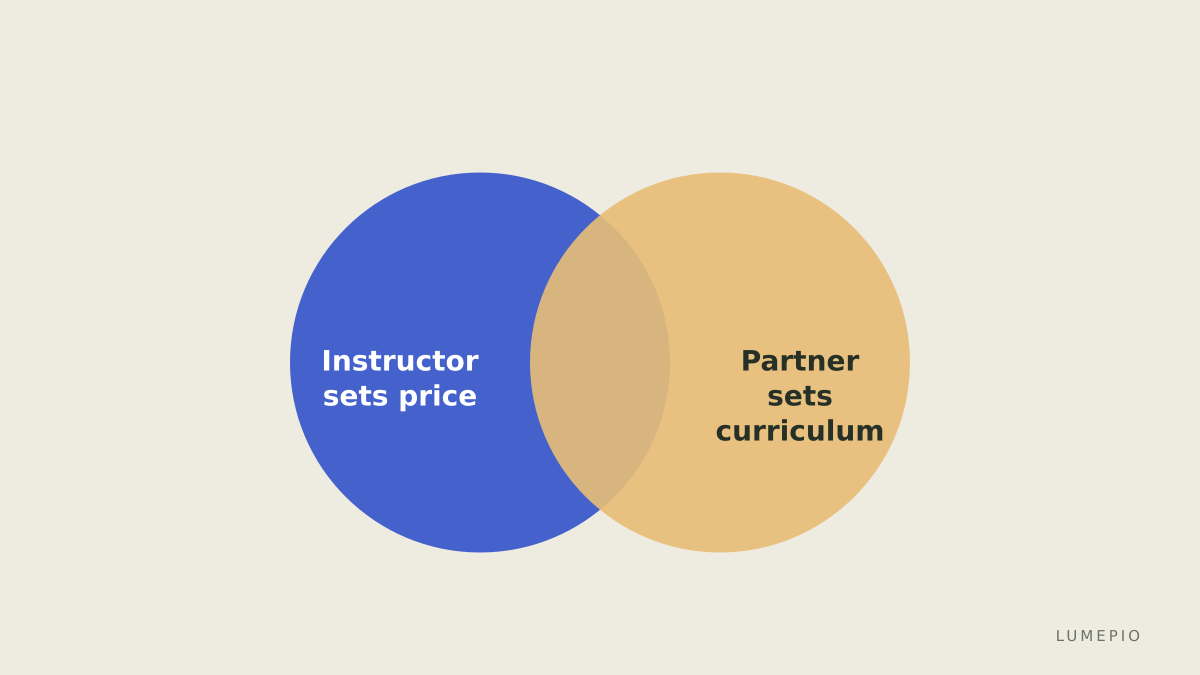
Udemy and Coursera are usually compared as if they were two shops selling the same product at different prices. They are not. One is an open marketplace where almost anyone can publish a course; the other is a distribution platform for universities and large companies. Nearly every difference people notice, from certificate value to refund rules to why one platform is always "on sale", follows from that single structural fact. This article explains the two models first, then works through what they mean for quality, credentials and cost.
Two models, not two catalogues
Udemy is a marketplace. Instructors create and own their courses, set a list price, and earn a share of each sale. The platform hosts and sells the courses but does not commission them, and it does not certify the instructor's credentials. That is why the catalogue is enormous and uneven: a niche tool can have a superb course made by a practitioner, and the same tool can have three outdated ones next to it.
Coursera is a partner platform. At the time of checking, Coursera describes working with more than 375 universities and companies, and its content is produced by those partners: courses, multi-course Specializations, Professional Certificates from firms such as Google, IBM and Microsoft, and full degrees. The partner's name sits on the credential, and the partner's reputation is on the line, which is why the catalogue is smaller and more consistent.
One note on ownership: at the time of checking, Coursera's own about page states that the company has combined with Udemy. For learners, the two sites still operate as distinct products with separate catalogues, pricing models and support policies, and this comparison treats them that way. Check each site for any changes before you buy.
What the model does to course quality
Because Udemy does not curate at the point of creation, quality assurance moves to the buyer. Useful signals are the last-updated date, the ratio of ratings to enrolments, whether the instructor answers questions in the Q&A, and whether the preview lessons show current versions of the software. Reading the one- and two-star reviews tells you more than the average score, because they describe the specific chapter where a course fell apart.
Coursera shifts that burden to the partner. A course from a university department goes through that institution's review, follows a syllabus with graded assignments and deadlines (flexible, but present), and is generally organised toward a defined outcome. The cost of this consistency is agility: Coursera courses on fast-moving tools can lag behind a marketplace course made last month by someone who uses the tool daily.
A fair summary is that Udemy's ceiling and floor are both further apart. The best marketplace courses are as good as anything on Coursera and often more practical; the worst are worse than anything Coursera would publish.
Certificates: what each one actually says
Aspect | Udemy certificate of completion | Coursera certificate |
|---|---|---|
Who issues it | Udemy, in the instructor's course name | Coursera together with the partner institution or company |
Accreditation | Udemy states it is not an accredited institution; certificates show completion, not formal credit | Not academic credit either, except within degree programmes; the partner's name carries the weight |
How it is earned | Finishing all lectures of a paid course | Completing graded assignments and passing thresholds |
Verification | Downloadable PDF and link | Shareable verified credential page |
Employer recognition | Signals initiative and the topic studied | Professional Certificates are designed with employers and named for the issuing company |
The practical difference is who is vouching for you. A Udemy certificate says "this person watched and finished a course by this instructor". A Coursera Professional Certificate says "Google (or IBM, or a university) considers this person to have passed our curriculum". Neither replaces a degree, but the second one is what recruiters searching profiles will recognise by name.
That said, certificates are not the main reason to choose Udemy. If your goal is to actually learn a tool, ship a project, or fill one specific gap for a job you already have, a practitioner-made Udemy course bought in a sale may be the cheaper and more direct route, and nobody will ask for the certificate.
Real costs: purchase vs subscription
The two pricing models are as different as the content models.
Udemy sells courses individually. You pay once and, under Udemy's lifetime access policy, keep access to that course while your account is in good standing and Udemy retains the licence to the course. List prices are largely notional because deep discounts are frequent; the price you should compare is the sale price you actually see. Udemy's refund policy allows a refund within 30 days of purchase, paid to the original method or as Udemy credit, with exceptions for abuse of the policy.
Coursera sells time. Most courses can be audited free (video and readings, no graded work or certificate). Paying unlocks grading and the credential. Professional Certificates are billed monthly while you are enrolled, starting, at the time of checking, at 49 US dollars a month with a seven-day trial. Coursera Plus bundles most of the catalogue for a monthly or annual fee (24 dollars a month or 160 dollars a year at the time of checking, with a 14-day refund window on the annual plan). Degrees and MasterTrack programmes are priced separately and excluded from Plus.
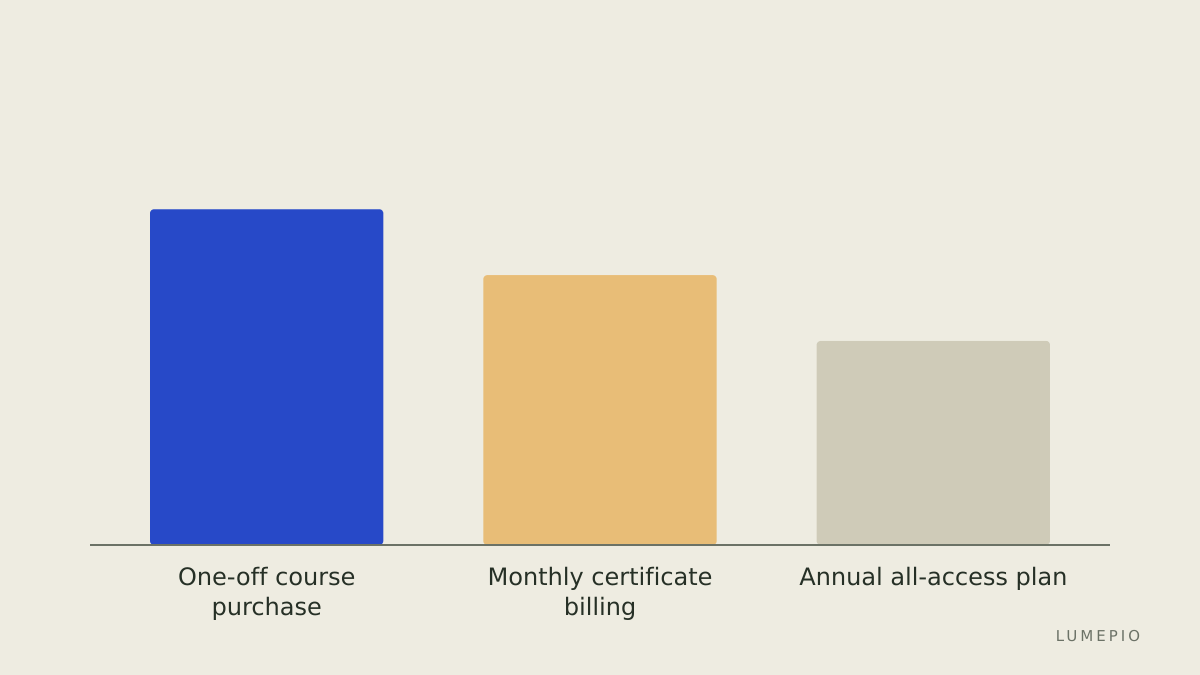
Two consequences follow. On Coursera, speed saves money: a certificate finished in two months costs a third of one finished in six. On Udemy, speed is irrelevant to cost, but you pay per topic, so a broad skill change across five subjects can end up costing more than a subscription. The sale-price psychology also cuts both ways: it makes single courses cheap, and it makes buying courses you never open very easy.
Which platform for which goal
Learning one tool for a task at hand (a spreadsheet function, a video editor, a framework): Udemy, chosen carefully by update date and reviews.
A recognised credential for a career change (data analytics, project management, IT support): Coursera Professional Certificates, because of the issuing company's name.
Academic depth in a subject (statistics, economics, a language's grammar): Coursera university courses, audited free if you do not need the credential.
Broad exploration on a small budget: audit on Coursera, buy one or two Udemy courses in a sale for the practical side.
Preparing for a specific vendor exam: Udemy practice-test courses are popular, but check that the exam version matches; certification bodies themselves usually offer official material.
Alternatives exist on both sides. edX runs a similar university-partner model to Coursera, and LinkedIn Learning offers a curated subscription library that sits between the two.
Conclusion
Udemy and Coursera differ because of who makes the courses, not because one is better. The marketplace gives you range, practitioner voices, one-off prices and lifetime access to what you buy, with the responsibility for judging quality on you and a certificate that mostly signals effort. The partner platform gives you consistency, deadlines and credentials with a recognised name, priced by the month, so it rewards finishing quickly. If you need a named credential, budget for Coursera and plan to finish fast. If you need to learn a specific skill and move on, pick a well-reviewed, recently updated course on Udemy, wait for the sale price, and use the 30-day refund window if the preview misled you.
Sources
- https://www.coursera.org/about
- https://www.coursera.org/courseraplus
- https://www.coursera.org/professional-certificates
- https://support.udemy.com/hc/en-us/articles/360050856093-Udemy-s-Refund-Policy
- https://support.udemy.com/hc/en-us/articles/14291607637015-Certificates-of-Completion-Frequently-Asked-Questions
- https://support.udemy.com/hc/en-us/articles/229603708-Lifetime-access