Learning English Online With the British Council: Free Resources vs Paid Courses
What the British Council's free LearnEnglish materials actually cover, what the paid English Online classes add, and how to decide by CEFR level and exam goal without paying for what you can get free.

Some links in this article lead to partner services. If you make a purchase there, the site may receive a commission; this does not affect the price or our assessment.
The British Council runs two quite different things under one name: a large free website called LearnEnglish, and a paid live-class service called English Online. People searching for "learn English online British Council" usually land on one and assume it is the whole offer. This guide separates the two, explains which learner each one serves, and shows how to combine them so that you pay only for the part that needs a teacher.
What the free LearnEnglish site covers
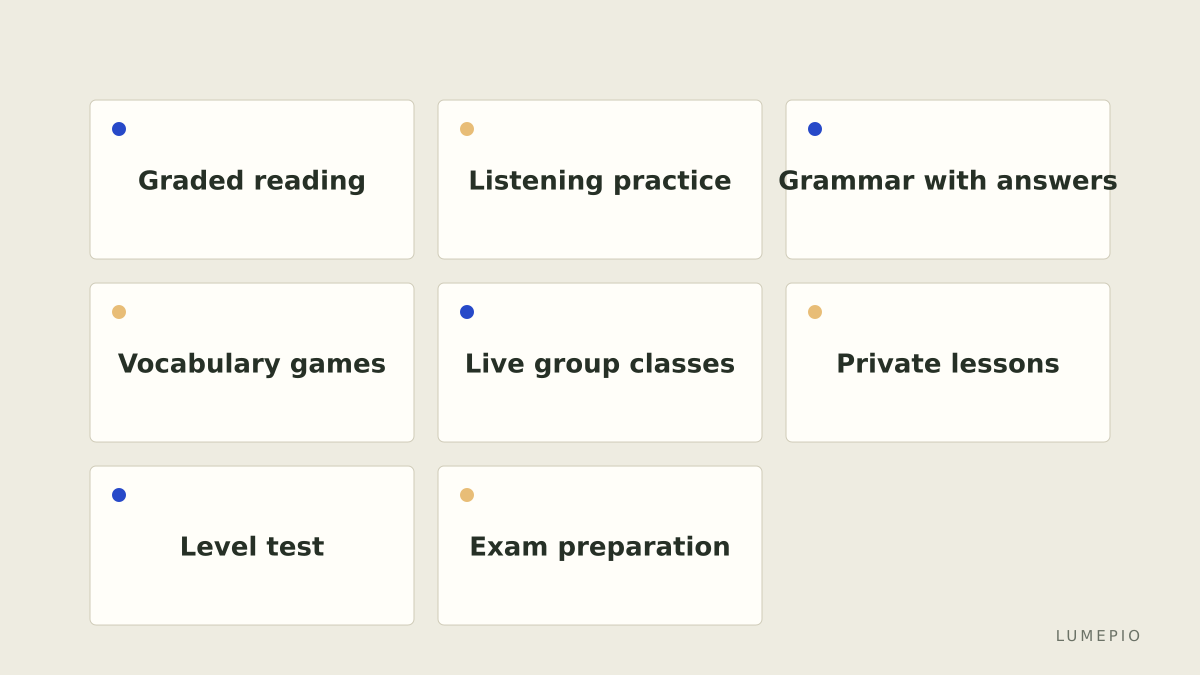
LearnEnglish is a self-study library rather than a course. At the time of checking, the site describes more than 10,000 learning activities organised by skill and by level: listening, reading, writing, speaking, grammar and vocabulary, each graded from A1 to C1 on the CEFR scale, with some C2 material. There is a separate Business English zone with podcasts for professionals, a general English zone with games, videos and stories, and free apps.
Three things stand out for a self-directed learner:
Everything is graded. You can filter listening practice, for example, to B1 only, which keeps you from drowning in material that is too hard.
Answers are built in. Exercises are self-checking, so grammar and reading practice give immediate feedback.
Registration is free. Creating an account unlocks progress tracking and additional resources without payment.
What the free site cannot do is talk back. Speaking practice is limited to recorded models and pronunciation drills; nobody corrects your sentence or asks a follow-up question. Writing tasks come with model answers but not with marking. For learners who mainly need input (reading, listening, grammar consolidation), that gap hardly matters. For learners who need output (speaking fluency, writing for work or exams), it is the whole problem.
What English Online adds
English Online is the paid arm. At the time of checking, it works on a credit system inside a monthly or annual subscription:
Group classes last 55 minutes, cost one credit and have a maximum of ten students.
Private one-to-one classes last 25 minutes and cost two credits.
Live25 sessions are 25-minute grammar or pronunciation webinars offered throughout the month to subscribers.
Teachers are described as qualified, experienced British Council English teaching professionals who specialise in online teaching, with training and quality monitoring in place.
The three monthly tiers (Silver, Gold and Platinum) roughly correspond to one, two or three group classes a week; annual plans sell blocks of 60, 120 or 180 credits. A seven-day free trial gives two credits, which means two group classes or one private class, and a free level test is available before you commit. Exact prices vary by region and currency, so check the current plans on English Online rather than relying on a number from any article.
The honest limitations are practical ones. Classes require your microphone and webcam to stay on for the whole session, which not every learner enjoys. The virtual classroom is optimised for Chrome and Firefox. Group classes are scheduled around the clock, but you are still fitting your life into a timetable, and the 25-minute private slot is short if you want extended conversation. If your main goal is cheap, unstructured speaking practice, a tutor marketplace such as italki or Preply may cost less per hour, at the price of losing the British Council's curriculum and teacher standards.
Choosing by CEFR level
The right split between free and paid depends less on budget than on where you sit on the CEFR ladder. Cambridge English publishes cumulative guided learning hours as a rough guide: about 180 to 200 hours to reach A2, 350 to 400 for B1, 500 to 600 for B2, 700 to 800 for C1, and 1,000 to 1,200 for C2. Guided hours means class time plus homework set by a teacher, and Cambridge stresses that these are guidelines, not promises.
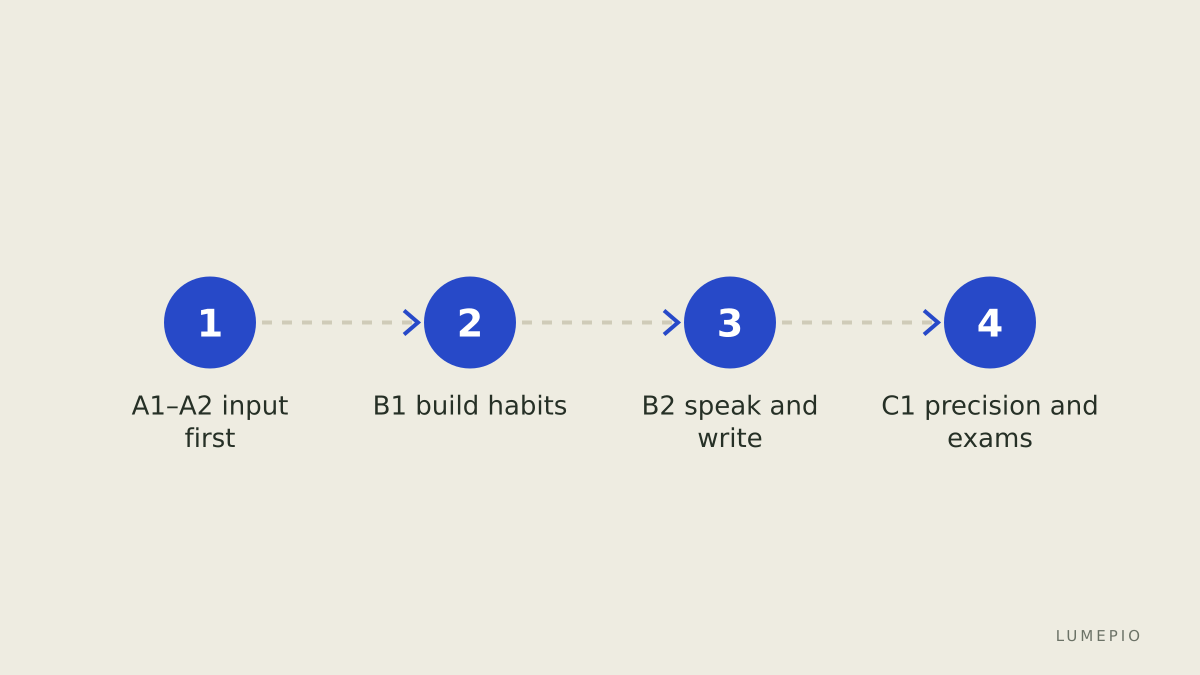
Read against that ladder, a sensible pattern looks like this:
A1 to A2. Most of the work is recognition: sounds, core grammar, the first two thousand words. The free site handles this well, and group classes at this level are largely about confidence. Paid classes are optional; a placement test is useful.
B1. This is where learners plateau. They understand more than they can say, and errors fossilise if nobody corrects them. One group class a week alongside daily free practice is the classic low-cost combination.
B2. Output starts to matter for work and study. Regular speaking with a teacher who corrects and pushes you pays off more than more reading. Two or three classes a week is where subscriptions begin to make sense.
C1 and above. Progress is about precision, register and exam technique. Private lessons or exam-focused courses give more value than general group classes, because the feedback is individual.
Free vs paid at a glance
Question | Free LearnEnglish | Paid English Online |
|---|---|---|
Cost | None; account optional | Monthly or annual subscription with credits |
Speaking practice | Recorded models and drills | Live group and private classes |
Feedback on writing | Model answers only | Teacher feedback in class tasks |
Schedule | Any time, self-paced | Booked classes, offered around the clock |
Levels | A1 to C1, some C2 | Beginner to advanced, placed by test |
Exam preparation | Free IELTS practice materials | Dedicated IELTS preparation courses |
Best for | Input, grammar, vocabulary, habit building | Fluency, correction, accountability |
Exam goals: IELTS and beyond
If you are studying for IELTS, the split becomes sharper. Listening and reading are objectively scored and can be drilled from free materials and practice tests. Speaking and writing are examiner-marked, and here candidates lose bands for problems they cannot hear in their own English: task response, coherence, range of grammar. The British Council runs dedicated IELTS preparation courses with mock tests, webinars and strategy sessions for different age groups; those are the components worth paying for, because they replicate the examiner's perspective.
A workable plan for a B2 candidate with three months:
Take the free level test and one full practice paper to find your weak sections.
Use free LearnEnglish materials for daily listening and reading at B2 and C1.
Book a limited number of live classes or an IELTS course focused on speaking and writing, and ask for written feedback on essays.
Repeat a practice paper monthly to check that scores move.
Availability of exam courses and payment options differs by country, so confirm on the British Council site for your region.
Conclusion
The free LearnEnglish site is a genuinely complete input library; for beginners and for anyone rebuilding grammar and vocabulary, it can carry most of the load. The paid English Online classes are worth their subscription when you have reached the point where nobody is correcting you, which for most adults arrives around B1 to B2, or when an exam deadline demands marked speaking and writing. Start with the level test and the free materials, notice where you stall, and only then decide whether a trial of the live classes fills that specific gap. Paying for a teacher to do what a website already does for free is the most common mistake; paying for correction when you need it is the most reliable use of the money.