Learning Your Partner's Language: A Realistic Guide for Bilingual Couples
When one partner learns the other's language, motivation, pacing and emotions behave differently than in a classroom. A long-form guide to why the effort matters, how to pace it over months, and the pitfalls that turn practice into conflict.

Couples who share a home but not a first language live with a quiet asymmetry. One person conducts the relationship in a language they learned; the other in the language they grew up in. Deciding to learn your partner's language is partly practical, partly an act of respect, and partly a long-term project that will test patience on both sides. This guide is about how to approach it realistically: why it is worth doing, how to pace it, and where couples most often go wrong.
Why the effort matters more than fluency
Most partners who start learning the other's language will not become fluent quickly, and that is fine. The value arrives long before fluency.
The first gain is access. Family gatherings, jokes, childhood stories, the tone of a phone call with a parent: these live in the native language and are flattened in translation. Understanding even a portion of them changes how present you can be.
The second gain is balance. When one partner always speaks a second language, that person carries a permanent cognitive load and, in arguments especially, a disadvantage. Every step the other partner takes toward the language redistributes that load a little.
The third gain is the simplest: the native speaker sees the effort. In many couples, the willingness to try is itself the message.
If you keep these three gains in view, a slow pace stops feeling like failure. You are not training for an exam; you are changing the texture of daily life.
Set an honest target
Language levels are usually described on the six-point CEFR scale from A1 (beginner) to C2 (near-native), as Cambridge English summarises it. For a partner's language, a useful first target is A2: you can follow simple everyday exchanges, understand what is happening around the dinner table, and hold a short conversation with a patient relative. Getting there typically takes months of regular practice, not weeks, and the exact time depends on how far the language is from the ones you already know.
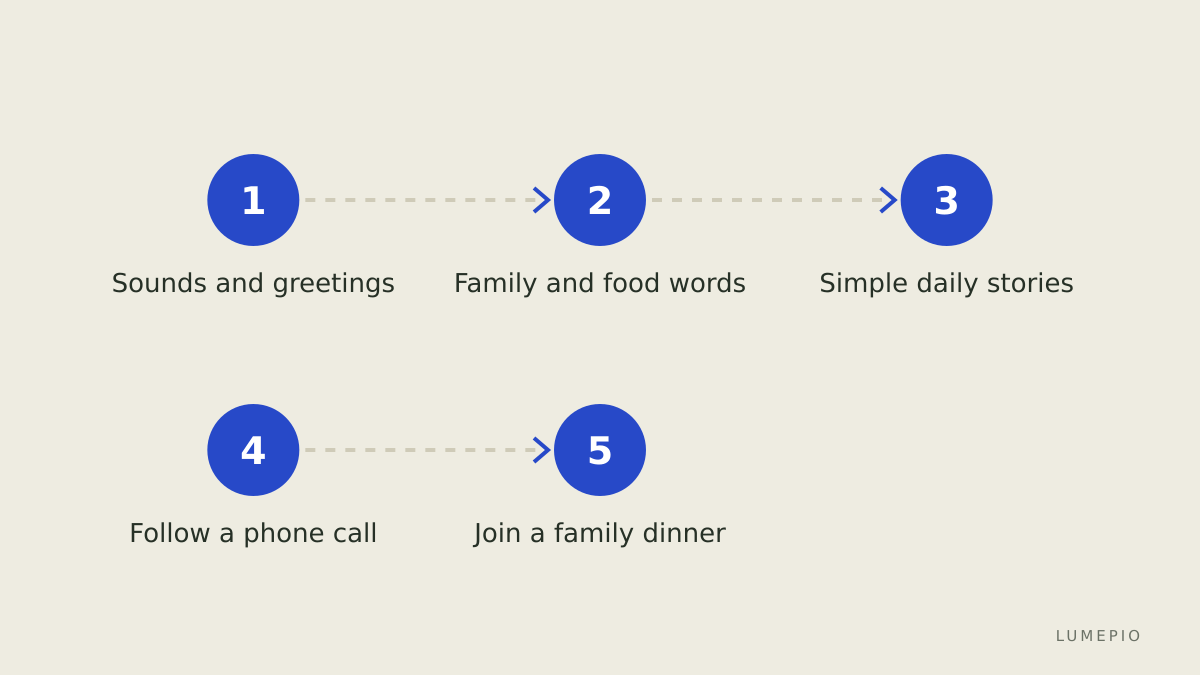
Set the target in behaviours rather than levels, because behaviours are what you will notice:
Understand the gist when your partner talks to their mother on the phone.
Order and pay in a restaurant on a visit to their country.
Read a short message from their family without a translator.
Tell a simple story about your day.
Write these down together. They become your progress markers, and they are far more motivating than a percentage on a screen.
Pacing: little and often, for a long time
The most common pacing mistake is the enthusiastic first month. A partner starts with an hour a day, the native speaker becomes an on-call teacher, and by week six both are exhausted and slightly resentful. Then nothing happens for four months.
A pace that survives contact with real life looks like this:
Rhythm | What it looks like | Why it works |
|---|---|---|
Daily, ten minutes | Vocabulary review, one voice message in the language, naming objects while cooking | Frequency beats duration for memory; it is small enough to survive a bad day |
Weekly, thirty minutes | One deliberate conversation on a chosen topic, with corrections allowed | Gives the native speaker a defined window to teach instead of being on call |
Monthly | A film or a family call in the language; write down what you understood | Measures progress in real situations rather than exercises |
Quarterly | Revisit the behaviour targets; adjust the plan | Prevents drift and lets you celebrate visible gains |
Expect plateaus. Around A2 most learners feel they have stopped improving even though comprehension is still growing. The cure is not more hours but more varied input: a different relative, a new topic, a television series with subtitles in the language.
The emotional pitfalls, and how couples avoid them
Learning inside a relationship is emotionally different from learning in a class. The teacher is also the person you argue with about dishes. Four pitfalls recur.
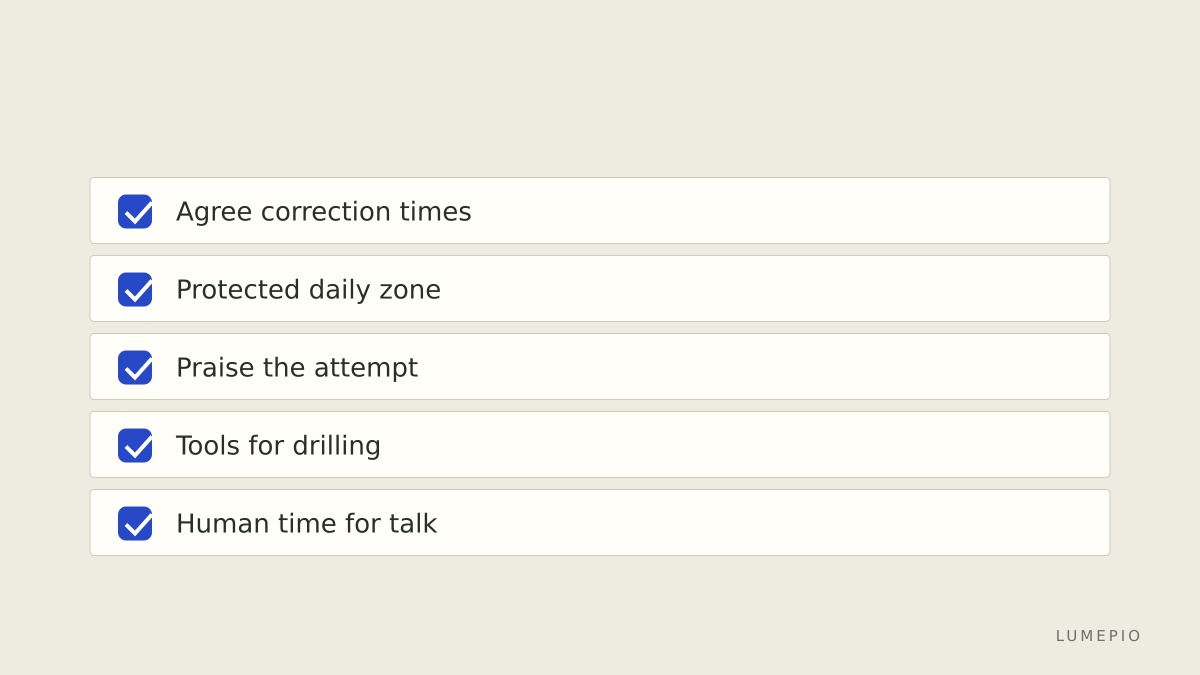
The partner becomes a teacher who never clocks off. Corrections at every meal turn the home into a classroom and the learner into a student. Agree on when correction is welcome (the weekly session, or a signal the learner gives) and when it is not (arguments, tiredness, in front of others).
Progress becomes a measure of love. A slow week is read as not caring. Name this early. The pace of learning reflects time, energy and how different the language is; it does not reflect commitment.
The native speaker gets bored. Repeating the word for spoon for the tenth time is not interesting. Shift some of the drilling to tools and keep the human time for real conversation, which is what the native speaker is uniquely good for.
Switching back too fast. When the learner struggles, the couple slips into the shared language and stays there. Set small protected zones instead: breakfast in the target language, or the walk to the shop. Ten minutes where switching back is not allowed does more than an hour of good intentions.
Tools that help, and how to use them without ruining dinner
Tools should absorb the tedious parts of learning so that the couple's time stays conversational.
For vocabulary drilling, any spaced-repetition app works; the point is that the learner reviews alone and arrives at conversations with words ready. For conversation practice with someone other than your partner, exchange apps such as Tandem and HelloTalk pair you with native speakers for text, voice and video, which takes pressure off the relationship and gives the learner a second voice to listen to.
For practice built around the couple itself, LinguaPair is an app made for exactly this situation; it is published by the same company as this site, which you should know when weighing our description. It combines a live translator for conversations between the two of you, courses from complete beginner level upward, and shared vocabulary built from the words you actually use together, plus games and paired streaks that keep both partners involved. The free tier at the time of checking includes ten minutes of translator use a day, the beginner levels and storage for a hundred words, which is enough to test whether the shared format suits you before paying. If you want a tool that treats you as a pair rather than as two separate learners, try LinguaPair together for a couple of weeks of ten-minute sessions.
Its limitations are worth stating plainly. It currently covers seven languages, so couples outside that set will need other tools. The translator is a bridge, not a replacement for effort; a couple that relies on it at every dinner will speak less, not more. And no app supplies the patience that the native-speaking partner has to bring. Alternatives that cover part of the same ground include a shared Anki deck for vocabulary, a weekly tutor for the learner alone, and structured course apps used side by side.
When the learner is the one who resists
Sometimes the partner who would benefit most from learning is the one avoiding it. Common reasons: fear of sounding childish in front of someone they want to impress, a bad school experience, or the sense that the other partner's fluency in the shared language makes the effort pointless.
The productive response is to lower the stakes rather than raise the pressure. Start with listening only, no speaking required. Learn the words for things you already love about their culture: food, music, a sport. Let the first spoken sentences happen with a stranger on an exchange app or with a tutor, where mistakes carry no relational weight. Fluency is a poor first goal for a reluctant learner; curiosity is a better one.
A guide's honest conclusion
Learning your partner's language is a multi-year project with early rewards. Set behavioural targets, keep the daily dose small, protect a short zone where the language is not optional, and separate the roles of partner and teacher deliberately. Use tools for the repetitive work so that the time you spend together is spent talking. If a shared app fits your habits, LinguaPair was built for couples in this exact position, with a free tier to start; check availability and current terms on its site, since they change. Whatever tools you choose, the decisive ingredient is a pace you can both sustain when the initial excitement fades.